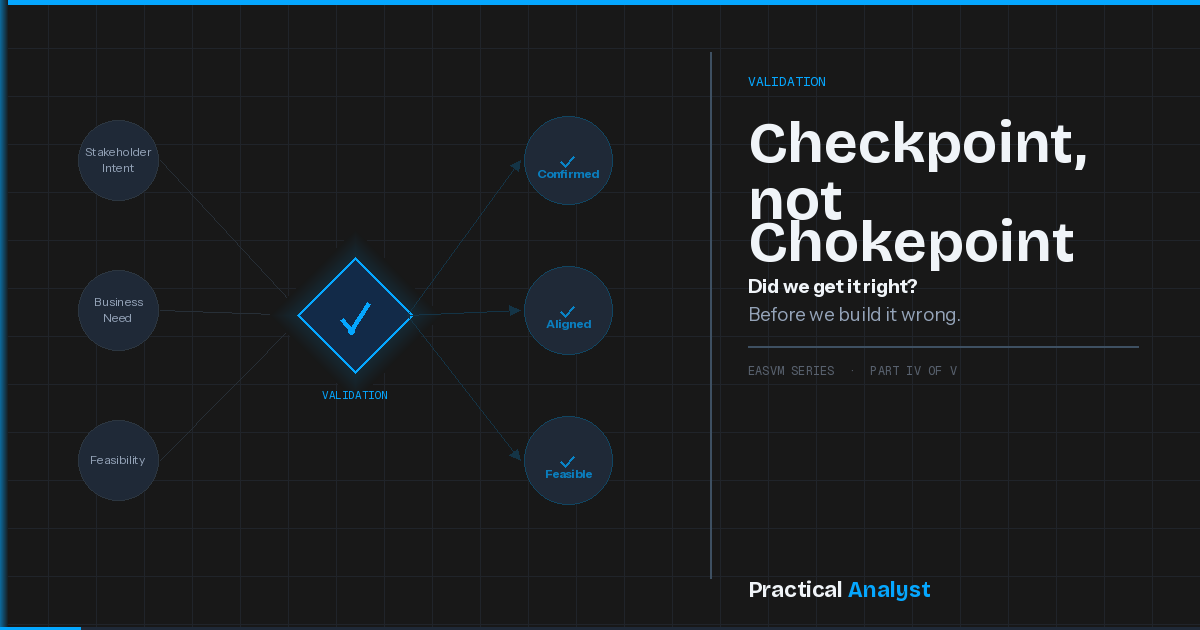
Validation is where we ask, “Did we get it right?” – before we build it wrong.
Validation is the practice of confirming that documented requirements accurately reflect stakeholder intent, align with business needs, and are feasible for delivery.
“We accomplish what we understand. If we are to accomplish something together, we need to understand it together.” – attributed to Ron Jeffries
Here’s the thing: validation shouldn’t be a heavy lift. If we’ve done elicitation, analysis, and specification collaboratively, stakeholders won’t be seeing the requirements for the first time; they’ll be recognizing what we’ve already discussed, clarified, and agreed to.
At that point, validation becomes a confirmation, not an investigation.
It’s also an opportunity to improve. Constructive feedback in validation doesn’t mean we failed; it means we’re learning, refining, and getting closer to delivering something useful and valuable that will enable our counterparts to design, build, and test the resulting solution.
Best practices for effective validation:
- Engage the right people. Validate with users, implementers, and decision-makers – not just approvers.
- Use real scenarios. Walk through examples or simulate usage to expose gaps and assumptions.
- Keep it conversational. Validation works best when it feels like a working session, not a formal audit.
- Focus on outcomes. Validate not just the content, but its alignment to the defined success criteria.
- Welcome rework… early. A revision in validation is many times cheaper than a redesign after deployment.
Validation is a checkpoint, not a choke point – when we build understanding as we go.
See other posts in the EASVM series:
Key takeaways
- Validation confirms that documented requirements truly reflect stakeholder intent, align with business needs, and are feasible to deliver.
- Done well it is a confirmation, not an investigation — if elicitation, analysis, and specification were collaborative, stakeholders are recognizing what they already agreed to.
- Treat it as a checkpoint, not a chokepoint: constructive feedback is not failure, it is refining toward the right solution.
Tip
If validation keeps surfacing surprises, the problem is upstream — collaborate earlier in elicitation and analysis so validation becomes a confirmation, not a rework session.

