Requirements don’t manage themselves!
Management refers to the ongoing coordination, traceability, and adaptation of requirements throughout the solution lifecycle. It’s how we maintain continuity and alignment, even as goals, constraints, and decisions evolve.
“You can’t control the wind, but you can adjust the sails.” – Unknown
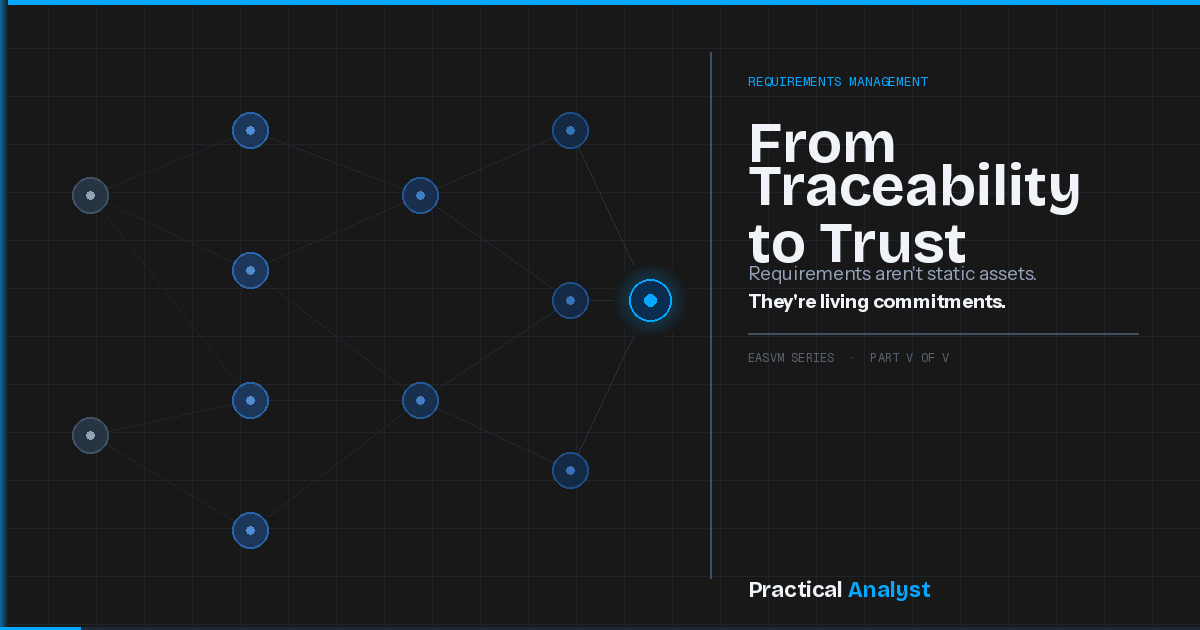
Requirements aren’t static assets. They’re living commitments. Managing them well ensures that the intent captured early remains intact after contact with delivery, change, and real-world complexity.
Think of requirements management like gardening: You don’t just plant once and walk away. You prune, water, and adapt to the environment to make sure what you’re growing is healthy and still worth harvesting.
Best practices for effective requirements management:
- Establish traceability. Link requirements to goals, design decisions, and tests.
- Monitor change proactively. Ensure updates ripple with awareness and intent.
- Continuously prioritize. As context changes, so may the priority and focus.
- Communicate impact. Surface the effects of changes before they become issues.
- Right-size the rigor. Govern just enough to protect value, without bogging down momentum.
Requirements evolve. Management is how we evolve with them, without losing our way.
Wrapping Up the EASVM Series
EASVM is only a framework, but with effort it can develop into a mindset for delivering clarity, alignment, and confidence at every step of solution definition.
- Elicitation starts the journey with curiosity and conversation.
- Analysis brings meaning and structure to complexity.
- Specification captures shared understanding in forms we can act on.
- Validation ensures we’re aligned before we invest.
- Management keeps it all connected, current, and on course.
Together, these disciplines create the conditions for success, not just in delivery, but in stakeholder engagement, strategic alignment, and meaningful results.
Thanks for following along! I hope this series has sparked ideas, clarified concepts, or simply reminded you of the importance of solution definition.
Let’s keep the conversation going!
Key takeaways
- Requirements management is continuous — coordination, traceability, and adaptation across the whole lifecycle, not a one-and-done capture.
- Treat requirements as living commitments, not static assets; the job is keeping early intent intact through delivery and change.
- Establish traceability (link requirements to goals, decisions, and tests) and monitor change proactively so updates ripple with intent.
Tip
Link every requirement to a goal, a design decision, and a test. That traceability is what lets you change course later without losing the thread.

