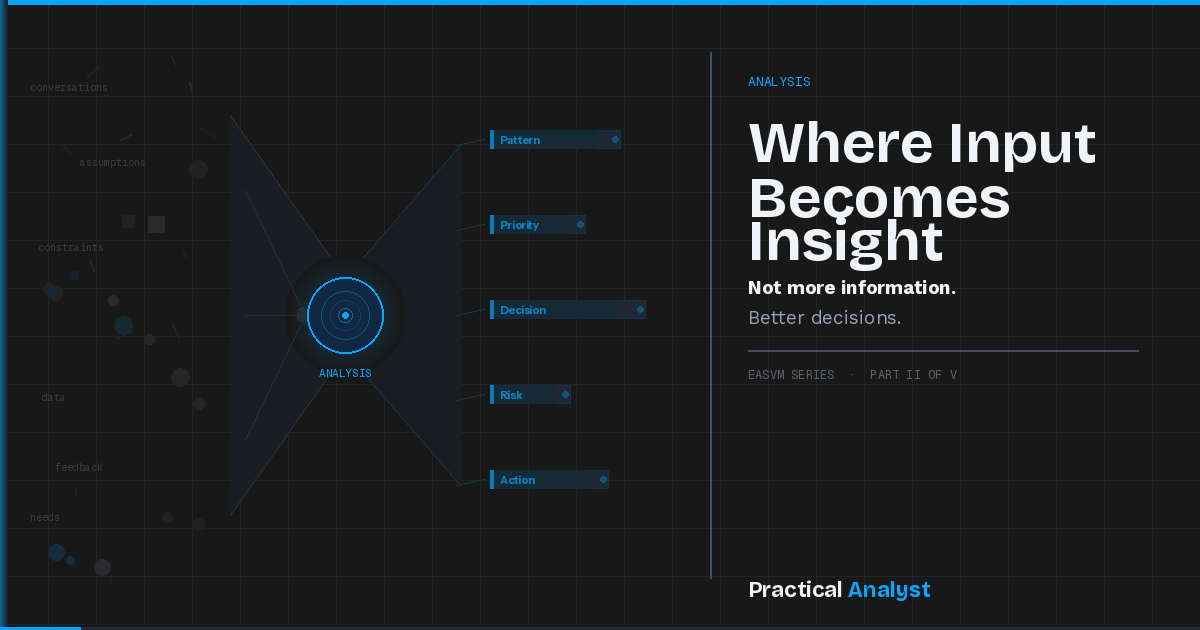
Analysis isn’t about taking what you heard and writing it down. It’s about figuring out what was really meant, what’s missing, and what matters most.
Analysis is the process of examining inputs: needs, data, conversations, constraints, and transforming them into meaningful, actionable insights. It’s how we uncover patterns, evaluate options, and connect the dots across domains.
In solution definition and delivery, this is where understanding becomes structure, and where misalignment is exposed before the cost to fix it grows exponentially.
Best practices for effective analysis:
- Ask “why?” and “so what?” Go beyond the stated need to understand its drivers and implications.
- Use models to think. Flows, maps, and diagrams aren’t just communication tools; they’re thinking tools.
- Balance detail with relevance. Zoom in where it matters, zoom out to see the whole.
- Engage others in sense-making. Analysis is strongest when it’s collaborative, not solitary.
- Trace decisions to outcomes. Link requirements to business goals to maintain focus and value alignment.
“The perfect is the enemy of the good.” – Voltaire (attributed)
But beware—analysis isn’t about perfection, it’s about momentum. Think of analysis as sharpening a blade: It needs to be sharp enough to cut cleanly, but if you keep honing forever, you never get to the cut.
A good analyst doesn’t just capture complexity; they clarify it. The goal isn’t more information. It’s better decisions.
See other posts in the EASVM series:
Key takeaways
- Analysis is not transcription — it is figuring out what was really meant, what is missing, and what matters most.
- It transforms raw inputs (needs, data, conversations, constraints) into actionable insight, exposing misalignment before the cost to fix it grows.
- Use models as thinking tools, ask “why?” and “so what?”, and balance detail with relevance — zoom in where it matters, out to see the whole.
Tip
Treat flows, maps, and diagrams as thinking tools, not just communication artifacts — modeling a problem is often how you discover what is missing.

