Think of specs as the GPS for delivery—useless if incorrect or unclear, essential when right.
Specification is the process of representing business or customer needs in a form that is clear, precise, and actionable for diverse audiences, from developers and testers to business stakeholders.
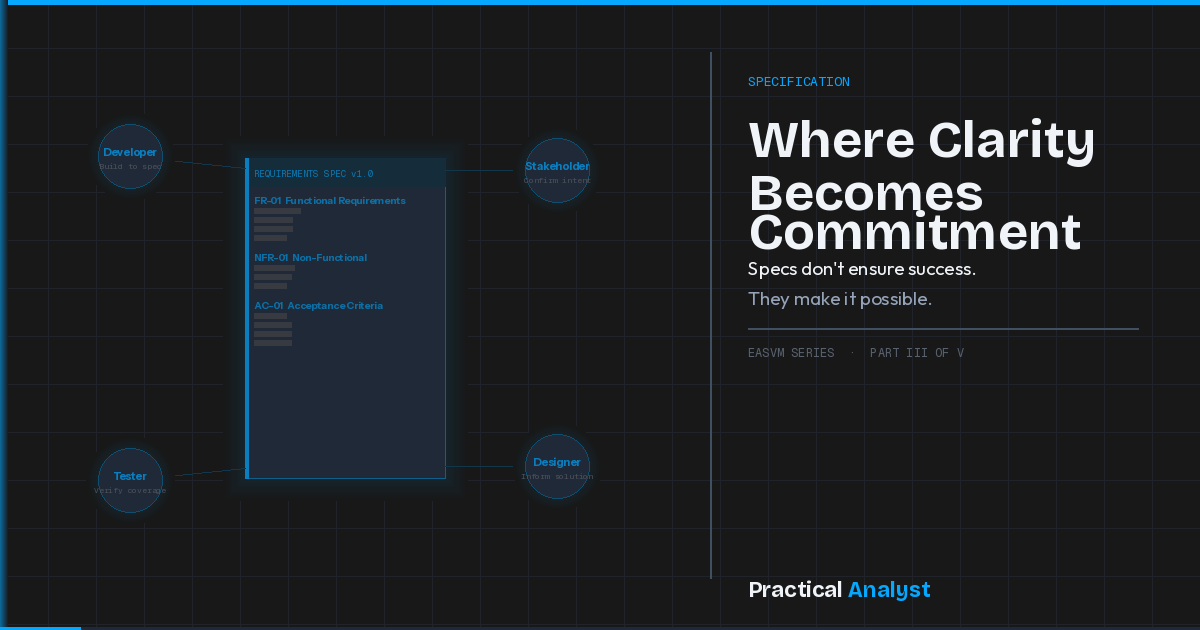
An appropriate and complete requirements specification does nothing to ensure a successful implementation; however, it makes it possible. – Kulak & Guiney
That’s the heart of it – specifications have no inherent value. Their worth lies in how effectively they enable others to understand, design, build, test, and deliver solutions that meet real needs.
A good specification doesn’t replace conversation; it recaps it. It’s not the start of communication, but the artifact that reflects the shared understanding reached through elicitation, analysis, and eventually, validation. It’s how we codify what we’ve agreed upon in a way that provides for traceability and consistency throughout the solution delivery process.
Best practices for effective specification:
- Tailor to your audience. Developers, testers, and sponsors each need information framed in their way. Write your specifications with their needs in mind.
- Be concise, not cryptic. Brevity with clarity beats exhaustive detail that no one uses.
- Visualize whenever possible. Diagrams, mockups, and flow diagrams communicate more than text alone and bring precision to combat the ambiguity of natural language.
- Connect to outcomes. Trace specs to the goals they support and the success criteria they serve.
The goal isn’t to create deliverables. It’s to create alignment and to enable action.
See other posts in the EASVM series:
Key takeaways
- A specification represents business needs in a form that is clear, precise, and actionable for every audience — developers, testers, and stakeholders alike.
- Specs have no inherent value; their worth is in how well they enable others to design, build, test, and deliver the right solution.
- A good spec recaps the conversation rather than replacing it — it codifies the shared understanding reached through elicitation and analysis.
Tip
Write the spec as a recap of a shared understanding, not a substitute for the conversation. If stakeholders haven’t talked it through, the document can’t paper over the gap.

