There’s a rhythm to effective solution definition, and it goes something like this: Elicitation. Analysis. Specification. Validation. Management. (EASVM, for short.) It isn’t the catchiest acronym or mnemonic, but it is a practical way to think about the full lifecycle of solution discovery and definition.
I learned about EASVM in a requirements training I did early in my career, and it has stuck with me since. Who does each element, how long they take, and what we call the outputs vary depending on delivery methods and other factors. But to create quality requirements or to perform discovery well, we’ll want to address them all. Too often, we focus on one part (usually documentation) and downplay the rest.
EASVM. Each element plays a distinct role:
- Elicitation brings needs to light.
- Analysis gives them shape.
- Specification makes them actionable.
- Validation ensures we’re aligned.
- Management keeps it all on track.
Let’s talk a little about each element, what it includes, and why it is important, beginning with Elicitation.
Elicitation
“The biggest problem with communication is the illusion that it has been accomplished.” – George Bernard Shaw
So many delivery issues trace back to this illusion.
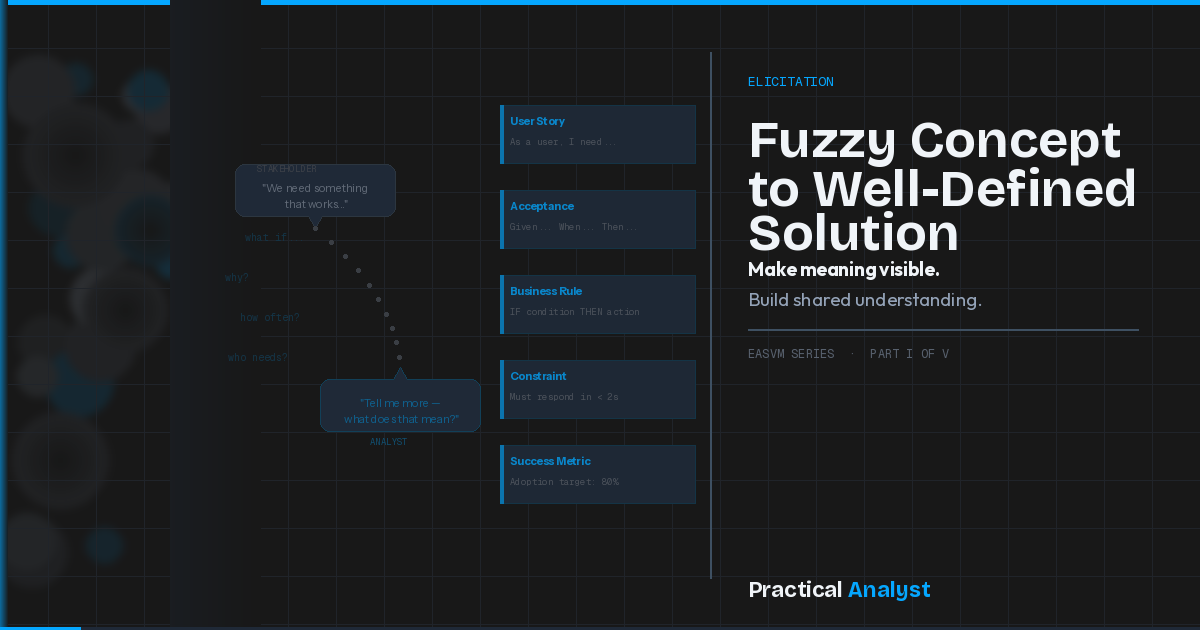
Elicitation is the intentional act of discovering, uncovering, and clarifying information through structured interaction. It’s not just about asking questions – it’s about making meaning visible.
In solution discovery and definition, elicitation is the foundation of shared understanding. It ensures we uncover not just what stakeholders say they need, but what they mean, what they value, and what they may not have thought to express.
Here are a few best practices for effective elicitation:
- Set the stage. Build trust and context before jumping into techniques. A stakeholder who feels heard will be more forthcoming.
- Diversify your methods. Don’t rely solely on interviews. Observation, workshops, prototypes, and surveys each reveal different layers of insight.
- Listen between the lines. Pay attention to what’s not said, and follow up on inconsistencies or assumptions.
- Visualize early. A sketch on a whiteboard often reveals more than an hour of discussion.
- Iterate often. Revisit and refine as understanding deepens – early alignment prevents downstream confusion.
The goal of elicitation isn’t documentation – it’s clarity. Because communication isn’t complete until understanding is mutual.
If communication is the currency of collaboration, elicitation is how we keep it honest.
In the related posts linked below, I break down the remaining elements: Analysis, Specification, Validation and Management. For each, we explore what it looks like in practice, why it matters, and how it contributes to shared understanding and better outcomes.
Let’s demystify the real work of discovery – one step at a time!
Key takeaways
- Strong solution definition follows a rhythm — Elicitation, Analysis, Specification, Validation, Management (EASVM) — across the full discovery-to-delivery lifecycle.
- Quality requirements come from addressing all five elements, not just documentation; each plays a distinct role.
- The roles, timing, and outputs flex by delivery method — but skipping any element is where fuzzy concepts stay fuzzy.
The EASVM lifecycle
- Elicitation — brings needs to light.
- Analysis — gives them shape.
- Specification — makes them actionable.
- Validation — ensures we are aligned.
- Management — keeps it all on track.

